
An AI scribe in 22 Indian languages
The language of every sentence is detected automatically; the transcript comes in the native script with an English translation.
 InstaPraxis · AI clinic OS · built in India
Booking and video consults, an AI scribe that understands 22 Indian languages and English, QR-verified prescriptions, a GST-ready clinic pharmacy and ten AI screening scans that run on a phone camera or microphone — in one login, for doctors, clinics and patients.

The Startup Special profiles InstaDataHelp and mentions InstaPraxis — its AI copilots, 35-second vital scan and QR prescriptions.
The language of every sentence is detected automatically; the transcript comes in the native script with an English translation.
Each drafted line links back to the transcript. An examination finding the conversation doesn't support must be confirmed before the note is final.
Upload up to 10 report files: every value is extracted, matched across labs, tracked over time and explained in the patient's language.
Patients answer in 13 languages, typed or spoken; the doctor opens the consult with a source-tagged AI brief and red-flag banner.
Skin score, skin age and 9–11 cosmetic skin metrics with care advice — alongside DR grading in RetinaScan and a newborn bilirubin estimate.
Your hospital's name, logo, colours, landing page, app icon and PDFs — semi- or fully white-labelled. See the live demos below.
Also: each doctor's own booking link and QR code, referral / sick-leave / fitness letters, a reader for other doctors' handwritten prescriptions, a household medicine cabinet, consultation mode (OPD or video) printed on every prescription, and patient details masked before any external AI call.
Open any of the three live demos. Each sign-in page offers one-click demo logins for a patient and a doctor — no sign-up needed.
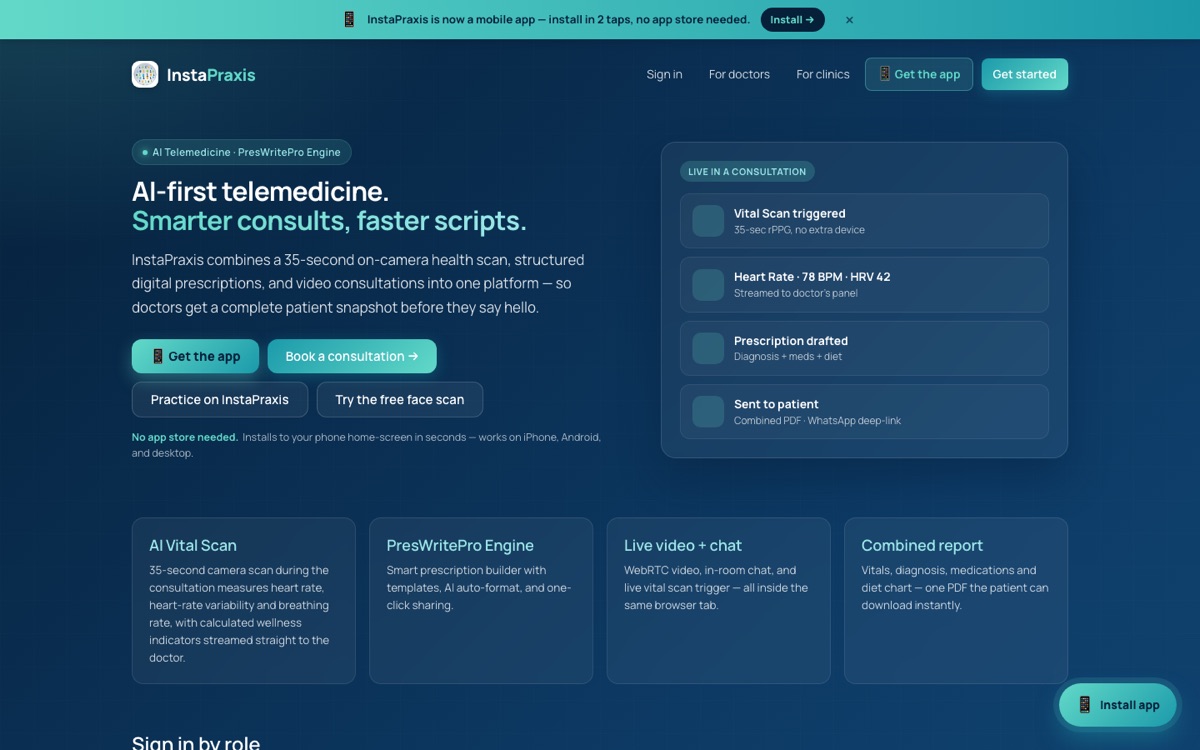
The full product under the InstaPraxis brand — for doctors and clinics who join the platform and start the same day.
Open the live demo →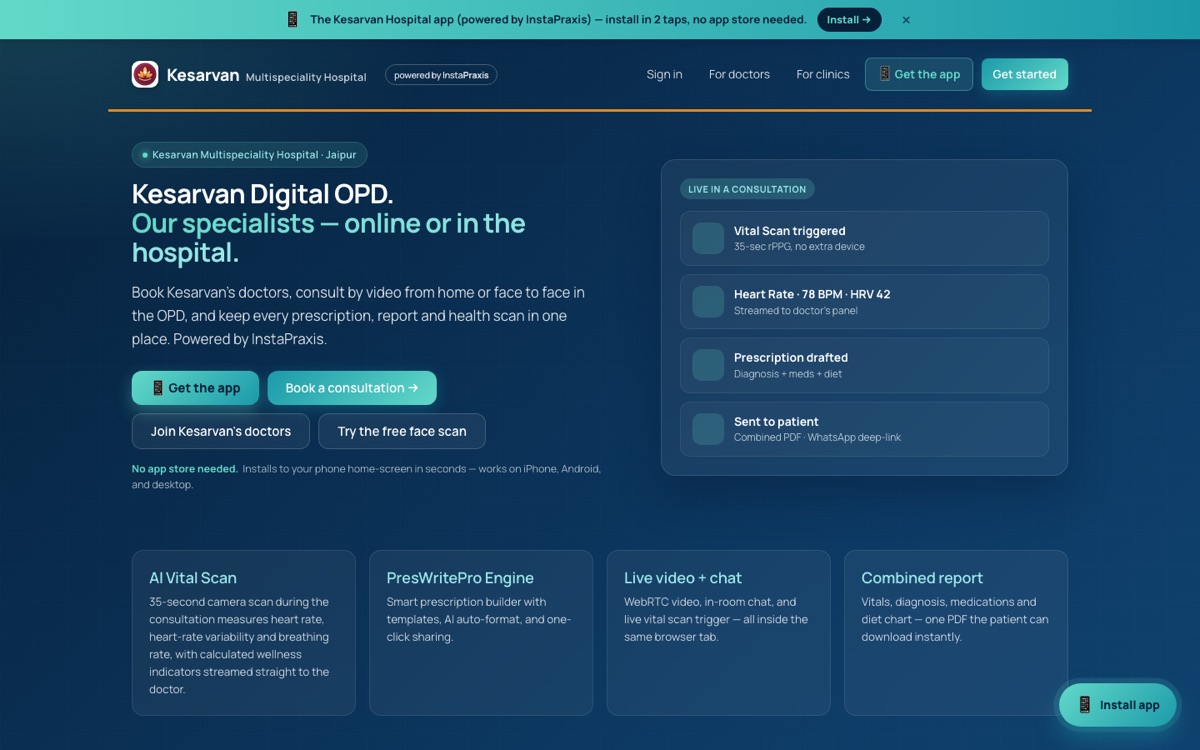
The hospital's name, logo and colours across the portal, app and PDFs — with a discreet “powered by InstaPraxis”.
Open the live demo →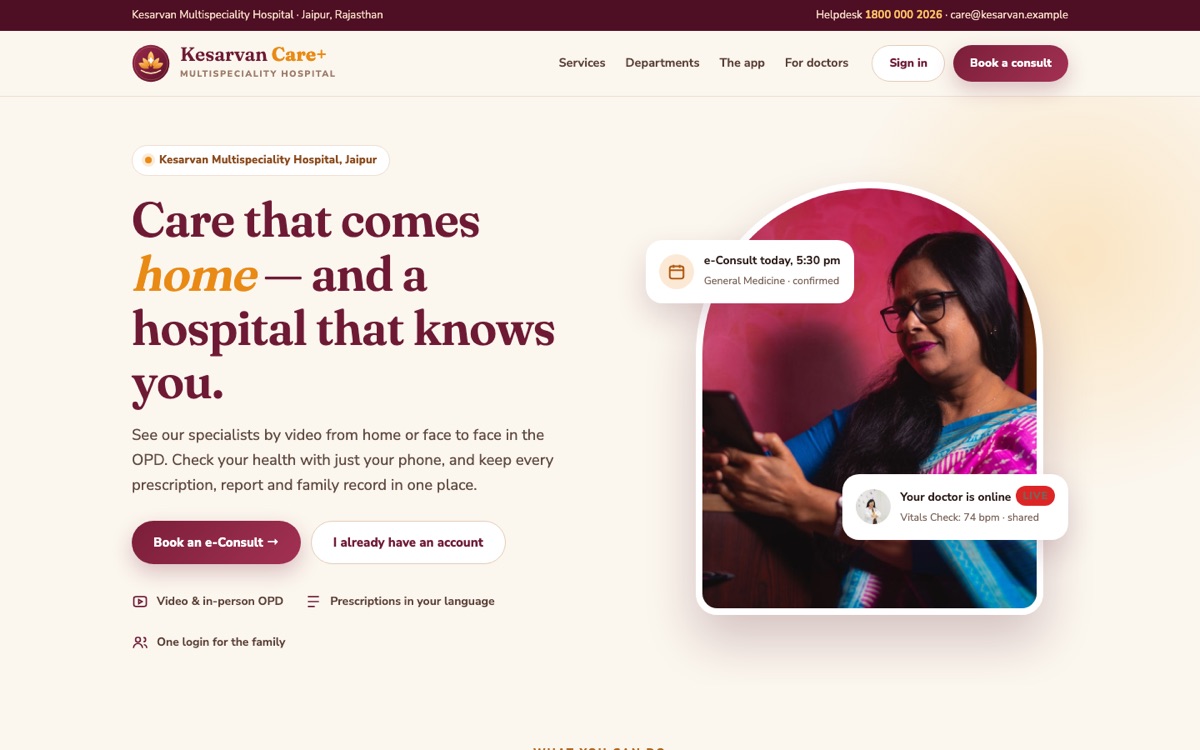
Entirely the hospital's brand: a custom landing page, its own names for features, recoloured prescriptions and reports — no InstaPraxis mention.
Open the live demo →Kesarvan Multispeciality Hospital is a fictional demo hospital with sample doctors, patients and prescriptions. Want a demo in your hospital's colours? Ask us.
Doctors trigger a scan on the patient's phone during a video consult and see the result in their panel; patients can run the same scans from their own portal. Pick a scan to see what it does — and what it doesn't.
Screening, not diagnosis. InstaPraxis scans are wellness and screening aids that support a registered medical practitioner's judgement. Every result is labelled decision-support and for research use; it does not replace a clinical examination, lab test or imaging report. If you feel unwell, see a doctor — in an emergency, seek care immediately.
Anyone can run a 35-second Vital Scan and download the PDF report — no account, no charge.
Try it now →Patients run all ten self-scans, keep each report as a PDF and share it with their doctor (access is appointment-gated and audited).
Create a patient account →The doctor launches the patient's scan remotely during the video call; results stream into the doctor panel and can be attached to the prescription.
Sign up as a doctor →Each Vital Scan value carries a badge so the doctor knows what was measured, what was worked out from the patient profile, and what is only an estimate.
Read from the face video. HRV and respiration appear only when the signal is reliable.
Heart rate · HRV (RMSSD, SDNN, pNN50) · respiration
Standard formulas from the measured heart rate and the details the patient enters (age, height, weight…).
BMI · BMR · TDEE · body fat % · body water · blood volume · HRmax · target-HR band · VO₂max · FINDRISC · Framingham
Indicative only, read as guidance.
Stress index (needs about 2 minutes of beats) · cardiac load risk
We deliberately do not estimate these from a camera.
SpO₂ · blood pressure
The scribe detects the language of every sentence on its own — its speech engine supports 22 Indian languages plus English, with Hindi, English and Hinglish tested most — and produces the native-script transcript plus an English translation. It then structures the conversation into chief complaint, history, examination and diagnosis, ready for you to check.
More Indian languages are being tested before we list them.
The Rx editor drafts from the consult notes, runs an AI safety review for interactions and dosing alongside formulary rules, and produces one combined PDF — vitals, diagnosis, medicines, a diet plan and the attached scan pages.
Each assistant only sees what its user is allowed to see. The AI never writes database queries — it can only call a curated set of read-only tools scoped to the user's role, and any change (booking, slots) is proposed first and applied only after explicit confirmation. Every AI call is logged.
“Show tomorrow's schedule.”
“What did I prescribe Mrs Iyer last visit?”
“Add Sunday slots, 10 to 1.”
“My upcoming appointments?”
“Show my latest scan report.”
“Find a slot with my doctor on Saturday.”
“Today across all doctors.”
“Book Mr Rao with the next free doctor.”
“What expires in the next 60 days?”
“Today's sales and margin.”
The clinic assistant switches to its pharmacy skills on the pharmacy and inventory pages. Example prompts are illustrative.
The same doctor publishes direct online slots and per-clinic OPD slots; walk-ins handled; a configurable doctor share per clinic with earnings pages for both sides.
Doctor roster, patient registry with phone lookup, appointments (book, reassign, cancel) and analytics.
GSTIN and drug-licence settings, batches and barcode lookup, prescription-to-bill, POS sales, returns and daily cash close.
Suppliers, purchase orders, goods receipt, stocktakes with variance, reorder suggestions, expiry and margin reports, CSV export.
WebRTC video with our own TURN relay, reconnect hardening, in-room chat and live transcript.
Android, iPhone and desktop install in two taps — no app store needed; offline app shell for appointments and prescriptions.
The patient app does the work that usually falls through the cracks: the history nobody had time to take, the report nobody explained, the medicines nobody tracked.
Nine questions in 13 languages, typed or spoken. A fixed emergency checklist tells the patient to call 112 when it matters.
The doctor opens the consult with a summary of the answers, every point tagged to its source, and a red-flag banner when warranted.
Photograph the BP monitor or glucometer screen and the reading is captured for the patient to confirm — with a 7-day average the doctor can see.
Up to 10 files at once. Every value extracted, names matched across labs, trends over time — explained in the patient's language, with a PDF.
The prescription in plain words in the patient's language, read aloud — and re-checked by a second, on-server safety model. Doses are never changed.
Photograph another doctor's handwritten prescription: medicines are read with a confidence score, and anything illegible comes back as “?”.
One household view of running and finished courses, with interaction and allergy notes.
Hospitals, clinics, pharmacies and labs nearby — no login needed, and the location is never stored.
Your own booking link and QR code — new patients pick a slot and are booked in four details. Referral, sick-leave and fitness letters and lab requests in a click.
One login holds several family members. Walk-in patients get portal access printed on their prescription slip.
A health digest in the app and by email, and whole-portal translation into the patient's language.
Direct online slots and clinic OPD slots are published side by side.
The patient books from the app and runs a Vital Scan from the Health Scans portal before the visit.
The consult runs over secure video; the doctor triggers a BreathScan on the patient's phone mid-call.
The conversation — Hinglish here — becomes a transcript, an English translation and structured notes.
AI draft, Rx-safety review, then a QR-verifiable PDF with the scan pages attached.
The pharmacist prepares the bill straight from the prescription and dispenses from stock.
Daily cash close, then a quick question to the clinic assistant: “Today across all doctors.”
An illustrative day · times are examples.
Booking, video, scribe, prescriptions and earnings in one place instead of four tools.
Separate OPD slots and revenue shares per clinic, plus your own direct online practice.
Prescription-to-bill dispensing, GST settings, purchasing, stocktakes and expiry reports.
TB, anaemia and jaundice screening on a phone — no extra hardware to carry.
Hospital groups: a hospital edition is in development — tell us what you need.
| Step | Separate tools | With InstaPraxis |
|---|---|---|
| Booking | A booking app that doesn't know your clinic OPD | Direct and clinic slots in one calendar, revenue share built in |
| Vitals & screening | Separate devices, or nothing in a video consult | Ten phone-based scans, triggered from the consult |
| Notes | Typed after the patient leaves | AI scribe in 22 Indian languages → English notes |
| Prescription | Handwritten or a plain PDF | Rx-safety review + QR-verifiable PDF with scan pages |
| Dispensing | Re-keyed into a pharmacy system | Bill prepared straight from the prescription |
| Questions | Exports and spreadsheets | Three dashboard AI assistants with propose-then-confirm |
Every AI result carries an audit stamp and a device label; inputs pass a quality gate; the clinician's attach or dismiss decision is logged, and clinical reads are recorded in an audit log.
A CDSCO Class B readiness file is in preparation — risk management (ISO 14971), software lifecycle (IEC 62304), clinical validation protocol, labelling and DPDP data protection. Nothing has been filed yet.
Face video, X-rays, audio and skin or eye images: on the device or our own servers. Text sent to AI (OpenAI by default, Anthropic Claude for some assistant actions) has names, phones, Aadhaar/ABHA numbers and other identifiers masked first. Photos of prescriptions, lab reports and device screens go to a vision AI model as they are. Nightly backups with 14-day retention.
ABDM (ABHA, HPR, HFR) integration is planned and not yet built.
No per-scan or per-feature add-ons — one monthly doctor seat. Hospitals wanting their own brand or servers: contact us for pricing.
Run InstaPraxis under your hospital's own brand — semi-white-labelled (“powered by InstaPraxis”) or fully white-labelled — on a dedicated server or inside your own network.
Larger groups wanting InstaPraxis on their own servers can talk to us about a self-hosted setup.
InstaPraxis is an AI-first clinic platform for Indian practices. In one login it covers online and walk-in appointments, video consultation, an AI scribe, AI-drafted prescriptions with a safety review and QR verification, ten AI screening scans, a clinic pharmacy with GST fields and billing, and three AI assistants — one each in the patient, doctor and clinic dashboards, with the clinic assistant also covering the pharmacy. Patients, doctors and clinics each get their own portal.
₹399 per doctor per month, with every AI feature included. White-label, dedicated-server and on-premise setups for hospitals are priced on request — contact us. Clinics can start with a 30-day pilot with all features unlocked and onboarding included — no commitment, no lock-in.
Partly, and we are honest about which part. The 35-second Vital Scan measures heart rate from the camera, and shows heart-rate variability and respiration only when the signal is reliable. Other numbers such as BMI, BMR or VO2max are calculated from the patient profile and labelled as calculated. InstaPraxis does not estimate SpO2 or blood pressure from the camera. All results are screening aids, not diagnoses.
Ten: Vital Scan (face camera), Skin & Glow (cosmetic skin analysis), DermaScan (skin), ChestScan (chest X-ray, including DICOM upload), BreathScan (cough and breathing), AnemiaScan (pallor), JaundiceScan, Eye / RetinaScan, MindScan (voice) and TB Screen. Doctors can trigger them during a video consult, and patients can run them from their own Health Scans portal. Each result is decision-support for a registered medical practitioner.
The scribe detects the language of every utterance automatically. Its speech engine supports 22 Indian languages — including Hindi, Bengali, Tamil, Telugu, Marathi, Gujarati, Kannada, Malayalam, Punjabi, Odia and Urdu — plus English; Hindi, English and Hinglish are the languages we have tested most. It produces the native-script transcript plus an English translation. It then turns the conversation into chief complaint, history, examination and diagnosis notes in English for the doctor to review. Live captions on the doctor's device run in the browser.
No. Every AI result is labelled as decision-support for a registered medical practitioner and for research use; it does not replace clinical examination or lab tests. We are preparing a CDSCO Class B readiness file (risk management, software lifecycle, clinical validation protocol and more), but nothing has been filed yet.
Patient records stay on our servers. Face video, X-rays, audio and skin or eye images are analysed on the device or on our own servers. Consultation text, lab-report content and de-identified scan findings are sent to OpenAI for AI features — with names, phone numbers, Aadhaar and ABHA numbers, PAN and addresses masked first. The assistants use OpenAI by default and Anthropic Claude for some action steps; they never run raw database queries, only read-only tools limited to the user's own role and records. Photos of prescriptions, lab reports and device screens are read by a vision AI model and cannot be masked. Clinical reads are recorded in an audit log, and data is backed up nightly with 14-day retention.
Yes. The free public face scan at instapraxis.instadatahelp.com/scan.html runs a 35-second Vital Scan and gives a downloadable PDF report with no account and no charge.
InstaPraxis installs as an app on Android, iPhone and desktop from the Get the app page in two taps — no app store needed. It keeps an offline app shell for appointments and prescriptions and shows an update prompt when a new version is out.
Yes. A semi-white-label portal shows your hospital's name, logo and colours with a discreet “powered by InstaPraxis”; a full white-label portal is entirely your brand, with a custom landing page, your own names for features and recoloured prescriptions and reports. Both are live as demos — see the “See it live” section on this page.
Not yet. ABDM integration is planned but not built today, so we do not claim it.
Still have a question? Talk to us or browse all our AI products.
All features unlocked, onboarding included, no commitment, no lock-in. Or try the free face scan right now.
instapraxis.instadatahelp.com · Sign in · Clinic login · Get the app
We set you up — doctors onboarded, availability configured, starter inventory loaded. One session.
You go live — patients book, run scans and receive QR-verified prescriptions.
You decide — we review the month with you, and you choose whether to continue.
